Principal Investigator: Dr. Sambandh Dhal
Assistant Professor, Data Science in Agricultural & Ecosystem Sustainability
Department of Bioproducts and Biosystems Engineering
University of Minnesota Twin Cities
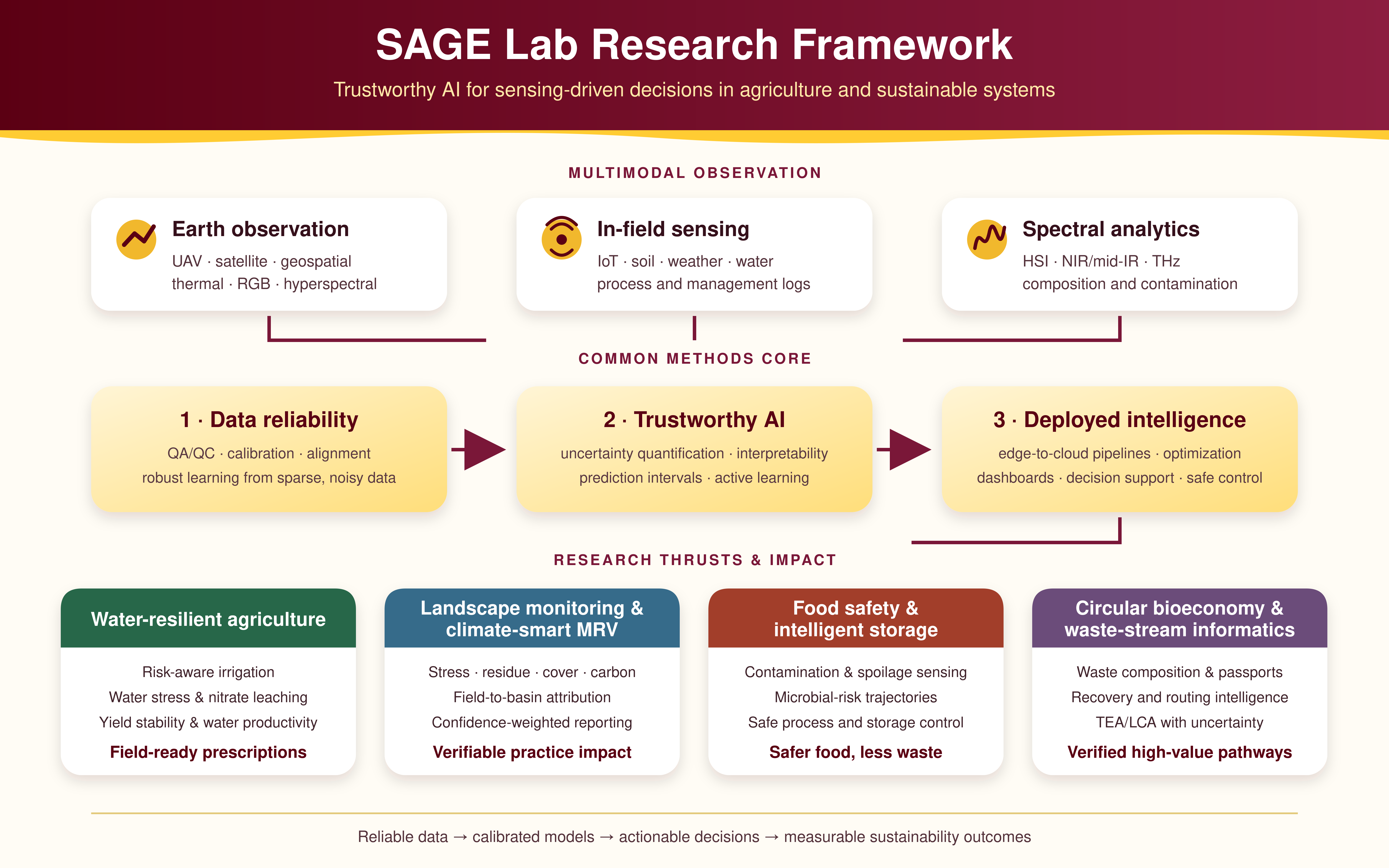
The Sensing, AI & Green Systems Engineering (SAGE) Lab develops reliable, data-driven methods that connect sensing → artificial intelligence → real-world decision making.
Our research focuses on developing reliable machine-learning and statistical methods for real-world sensing data, particularly when datasets are small, noisy, sparse, incomplete, heterogeneous, discontinuous, or high-dimensional.
A central goal of the lab is to move beyond AI systems that simply generate predictions. We develop methods that also quantify uncertainty, reliability, and confidence, helping determine when a prediction can be trusted and when additional information or intervention may be needed.
Core Research Methods
Our methodological research includes:
- Trustworthy and uncertainty-aware machine learning
- Machine learning for small and limited datasets
- Statistical error estimation and model validation
- Multimodal sensor and data fusion
- Hyperspectral and spectroscopic data analytics
- Computer vision and image-based learning
- Time-series modeling and alignment
- Transfer learning and domain adaptation
- Learning from noisy, incomplete, and high-dimensional data
- Real-time and edge AI
- Optimization and decision-making under uncertainty
- Data-driven process monitoring and adaptive control
Sensing and Data Modalities
The SAGE Lab works with diverse sensing platforms and data sources, including:
- Hyperspectral and multispectral imaging
- NIR, MIR, FTIR, Raman, and related spectroscopic measurements
- RGB and thermal imaging
- IoT and environmental sensors
- UAV and satellite remote sensing
- Process and equipment data
- Multimodal and heterogeneous datasets
Application Areas
We translate these methods into practical sensing and decision-support tools for:
- Precision and digital agriculture
- Agricultural and ecosystem sustainability
- Food quality, food safety, and processing
- Controlled-environment agriculture
- Biomass and bioenergy systems
- Environmental monitoring
- Circular bioeconomy and waste-stream informatics
- Automated material identification and sorting
- Sustainable materials and materials informatics
Our Research Philosophy
Real-world AI rarely operates on clean, complete, and perfectly balanced datasets. Measurements may be noisy, sensors may fail, observations may be limited, and new data may differ from the conditions used to train a model.
The SAGE Lab develops methods that explicitly account for these challenges and translates them into practical sensing, monitoring, optimization, and decision-support systems.
Our goal is to build AI that knows when it does not know—so sensing-driven decisions are reliable enough to trust.